How smart lighting in a Dubai villa actually works
Smart lighting is not a lamp you buy. It is a decision about circuits and control, taken weeks before anybody chooses a fitting.
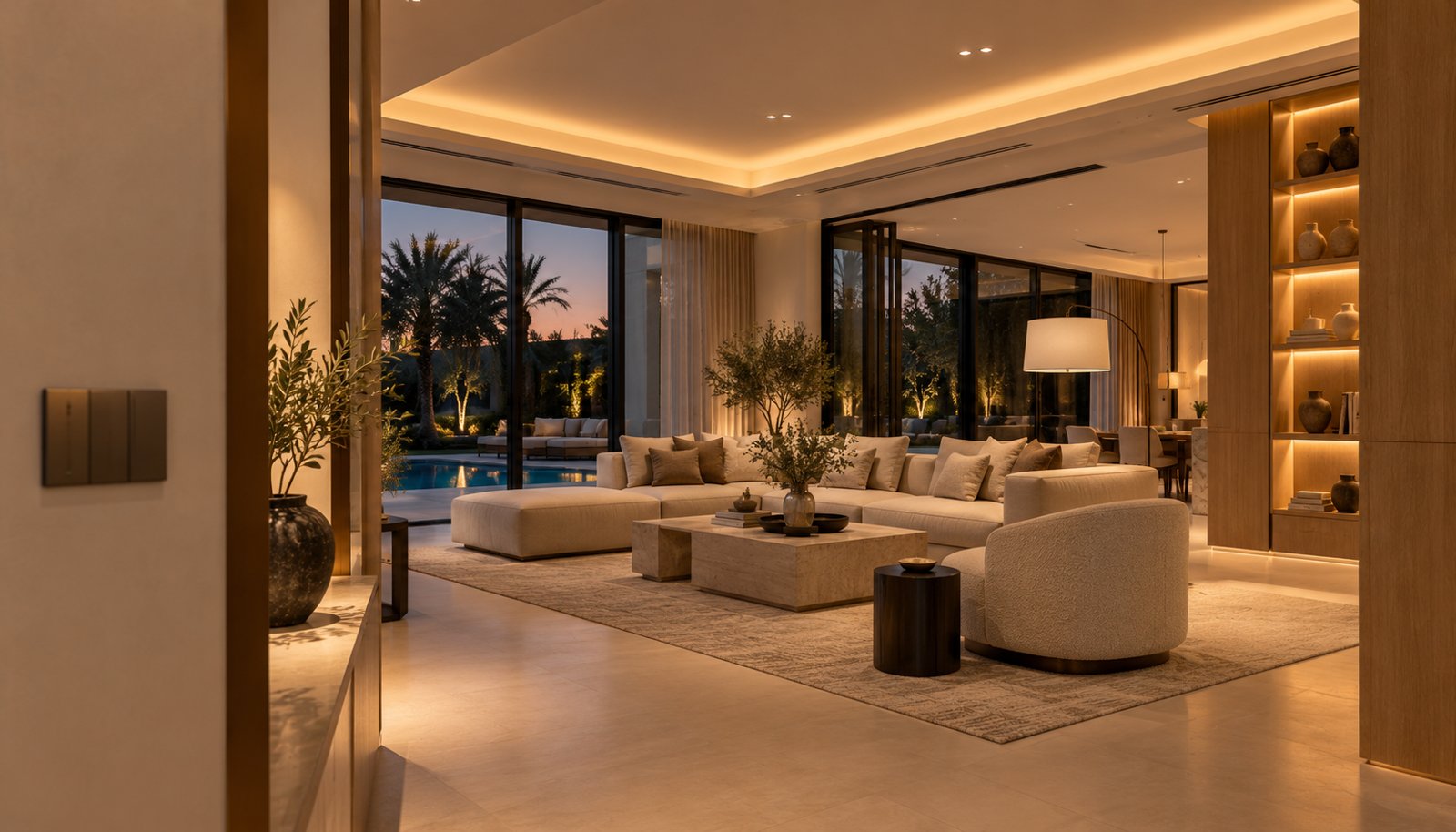
Smart lighting is not a lamp you buy. It is a decision about wiring, made weeks before anyone chooses a fitting.
Most villas in Dubai are handed over with the same lighting: a grid of identical downlights, one switch by the door, everything on or off. It works, in the way a strip light in a garage works. The difference between that and a house that feels calm in the evening is not the fittings — it is how the circuits were planned and what controls them.
What smart lighting actually means
Three different things get sold under the same name, and they are not equivalent.
- Smart bulbs. Individual lamps with their own app. Cheapest, no wiring changes, and they stop working as a system the moment someone uses the wall switch.
- Smart switches and dimmers. Standard fittings, intelligence in the wall. A sensible middle path in an apartment or a renovation where wiring is not being redone.
- A wired control system. KNX and similar: the lights are dumb, the system is central, and switches are inputs rather than on-off devices. This is the version that has to be decided before first fix, because the cabling is different.
Only the third one behaves like a building system: scenes across rooms, one off button for the whole villa, integration with blinds, air conditioning and the gate. The first two are convenience.
What has to be decided before first fix
- Which circuits exist in each room. Not how many lights — how many separately controlled groups. A living room with one circuit can never have an evening setting.
- Where the control sits. A central panel needs space, ventilation and access; wireless systems do not, but trade reliability for it.
- Dimming. Whether a fitting dims, and well, depends on its driver, not on the wall switch. This pairs the fitting and the system, and it is the single most common source of flicker and buzz afterwards.
- Colour temperature. Warm in the evening, neutral where people work. Mixing them randomly across one open plan is what makes a new house feel like an office.
- Switch layout. How many plates, where, and what each one does. Eight identical buttons by a door is a design failure, not a feature.
Ask for the lighting plan and the switch schedule before first fix, not samples of fittings. A fitting can be swapped in an afternoon; a missing circuit means opening a ceiling.
Layers, not brightness
Good lighting in a Dubai home is rarely about more light. It is four layers used separately: general light for moving around, task light where something actually happens — worktops, the desk, the mirror — accent light on what deserves attention, and low-level light for late evening. The scenes a control system holds are simply pre-set mixes of those layers, which is why the layers have to exist in the wiring first.
Outside the house
Garden and terrace lighting benefits more from control than the interior does: a single scene that lights the route, the trees and the pool edge at low level is the difference between a garden used after dark and one that is a black window. Community rules limit what can go on the house and on boundary walls, which pushes the design to ground level anyway — and that is covered in landscaping a Dubai villa garden.
What drives the cost
- The number of controlled circuits. This, more than anything, sets the size of the system.
- Wired or wireless. Wired costs more in cable and labour and far less in frustration.
- Dimmable drivers and quality of fittings. Cheap drivers are where flicker comes from.
- Integration. Lighting only, or lighting plus blinds, air conditioning, audio and access.
- Programming. Someone has to set the scenes up and hand them over working, and that is a line item, not a favour.
Where it goes wrong
- Buying the system after the ceilings are closed.
- Fittings and dimmers that were never tested together, discovered as buzz or flicker at handover.
- Too many scenes. Families use three or four. Twenty is a demo, not a home.
- Nothing works without the app. Every room should still be usable from a wall switch by a guest or a child.
- No documentation. If the person who programmed it disappears, somebody else has to be able to change a scene.
How the wider automation picture fits together is in smart homes in Dubai, and the order in which these decisions arrive during a renovation is in the ten choices that decide how a Dubai renovation turns out.
What to ask before signing
- How many separately controlled circuits are there per room?
- Is the system wired or wireless, and who supports it?
- Have the chosen fittings been tested with the chosen dimmers?
- Which scenes will exist on day one, and who programmes them?
- Does every room still work from the wall if the network is down?
- What is handed over at the end — drawings, addresses, passwords?
Lighting is the part of a renovation people notice every evening and almost never ask about at the start. It is also the cheapest thing to get right while the walls are open, and among the most expensive to fix once they are closed.