How a villa renovation in Dubai actually runs, week by week
Five months on site, and three of them look like nothing is happening. Here is what each stage costs if it slips, and what has to be decided before it can start.
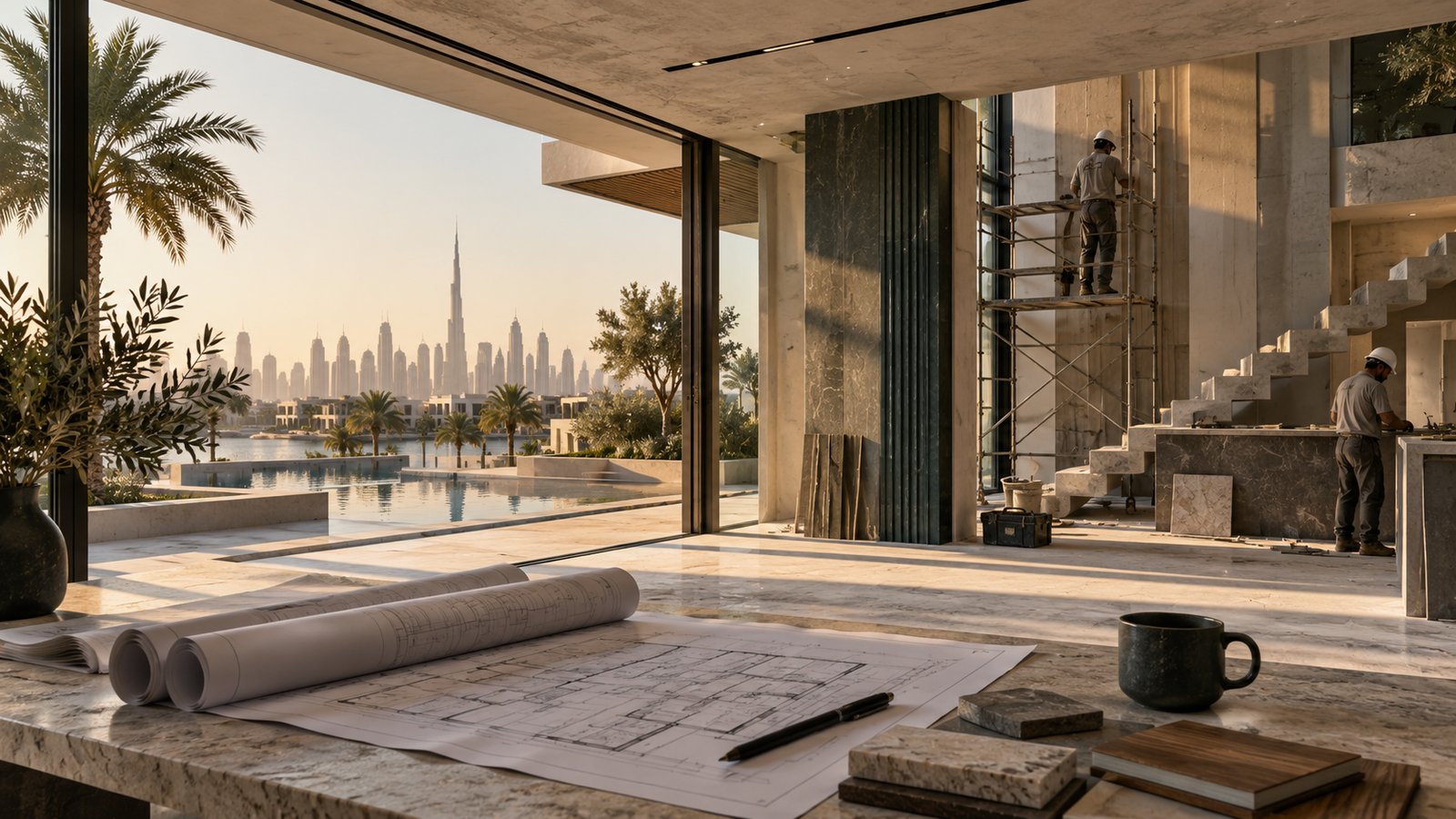
A renovation programme is a chain, not a countdown. Every stage waits for the one before it — which is why the delays that hurt happen weeks earlier than the stage that breaks.
A soft refurbishment runs six to twelve weeks. A full internal renovation — new layouts, new MEP, new joinery, proper lighting — runs four to eight months. What follows is the second kind, on a four-bedroom villa of around 4,000 sq ft with no change to the external envelope: roughly twenty-two weeks on site.
Most guides stop at listing the stages. The useful part is the other two columns — what the site will look like while it happens, and what decision has to be closed before it can start.
What a week is worth
Before the stages, the number that makes all of this concrete.
Anyone renovating a villa they normally live in is paying twice for the duration: the villa, and wherever they are staying instead. On a property that rents in the AED 250,000 to 400,000 range, every week of overrun costs somewhere between AED 5,000 and 8,000 in rent alone, before storage and moving twice.
That figure is the honest argument for spending an extra fortnight on design. Six weeks saved on site pays for a great deal of decision-making up front.
The pre-site phase — design, approvals and ordering long-lead materials — is covered separately in when is the best time to renovate. Everything below starts the day the crew arrives.
Weeks 1–2 · Strip-out
Protection goes down over anything staying, skips arrive, the crew is registered with the community. Then the soft strip: sanitaryware, joinery, doors, loose finishes.
Fast, visible, satisfying. It is also the last cheap week.
Closed before this starts: the full scope. Anything still open now becomes a variation order later, priced without a competing bid.
Weeks 3–4 · Demolition and blockwork
Walls out, new blockwork in, openings formed. The villa is at its loudest and dustiest, and this is when hidden conditions surface — old plumbing, a slab level that does not match the drawings, cabling running somewhere nobody expected.
Where the date slips: as-built rarely matches the developer's drawings. A measured survey during design finds this for the price of a morning. Demolition finds it for the price of remanufactured joinery.
Weeks 5–7 · First fix
Wiring, pipework, drainage and ductwork go into the walls and floors. Expect to visit and see nothing recognisable as progress — bare blockwork, cut chases, cables hanging.
These three weeks set the electricity bill for the next decade, and they are the only window in which moving a socket is free. After plaster, it is a day's work and a patch that will always be visible. After the screed, moving a drain is three weeks and a re-test.
Closed before this starts: the position of every socket, switch, light, tap and appliance. Not the models — the positions. Still choosing in week 12 something the site needed in week 5 is the most common cause of a Dubai renovation running late.
Weeks 8–11 · The quiet weeks
Plaster, screeds, waterproofing. Then the wet areas are flooded and left.
This is the stretch that generates the phone calls. Site visits show an empty house, no noise, nobody working — and it is entirely normal. Screeds cure on their own schedule and will not be hurried. A proper flood test sits for 48 to 72 hours with nothing else happening in that room while somebody checks the ceiling below.
The flood test is the one stage worth losing days on. The alternative is finding the leak after the tiling, the ceiling and the joinery are in — at which point three weeks of finished work comes back out.
Weeks 12–14 · Tiling and stone
Floors and walls, wet areas first, set out from the room's centre lines rather than a corner. That single decision is the difference between a bathroom that looks designed and one that looks tiled.
Closed before this starts: physical samples approved in the actual room, at the hour of day it will be used. Dubai light is harsh and directional — a stone that reads warm grey in a showroom photograph can read distinctly pink on site.
Weeks 15–18 · Ceilings, paint and joinery
False ceilings, coves, lighting apertures, first coats of paint against bare walls. Then the kitchen, wardrobes and vanities go in.
The stage everyone waits for, and the one most often waiting on a delivery. Joinery fitted against out-of-square walls shows immediately — which is what those quiet plastering weeks were for.
Weeks 19–20 · Second fix and clean
Switches, light fittings, sanitaryware, taps, ironmongery, AC grilles. Final paint, protection off, builder's clean and then a deep clean.
Week 20 is the first week it looks like a home rather than a site, and the point at which most people want to move in. Two weeks too early.
Weeks 21–22 · Commissioning and handover
Every system tested and balanced: air conditioning room by room, water pressure at the furthest outlet, drainage falls, lighting scenes, automation. Then the snag list — the contractor's first, the owner's second — closed, re-checked and signed off.
Where the date slips, and it is worth letting it: commissioning is where uneven cooling gets corrected instead of lived with for two summers. Moving in before it is finished trades a fortnight for a decade of small irritations.
What the date actually depends on
Three things, and only one of them belongs to the builder.
- Decisions closed on time. Every stage above has a deadline attached. Miss one and the cost is not a day, it is the stage.
- Long-lead materials ordered during approvals, not after demolition. One late delivery holds every trade behind it while the labour on site is still being paid.
- How many companies are involved. When design, procurement, joinery and construction sit with different firms, nobody owns the programme, and every handover between them leaks a week.
The specific ways budgets and dates come apart are set out in 10 costly mistakes that blow up a renovation budget. The programme itself, though, is mostly decided in the first six weeks — before a single wall comes down.