Arabian Ranches 3 renovation guide: what to change first in your townhouse
The first homes in Arabian Ranches 3 have been lived in for a few years now. The snagging is done — the question has become what the developer layout does not do for the family living in it.
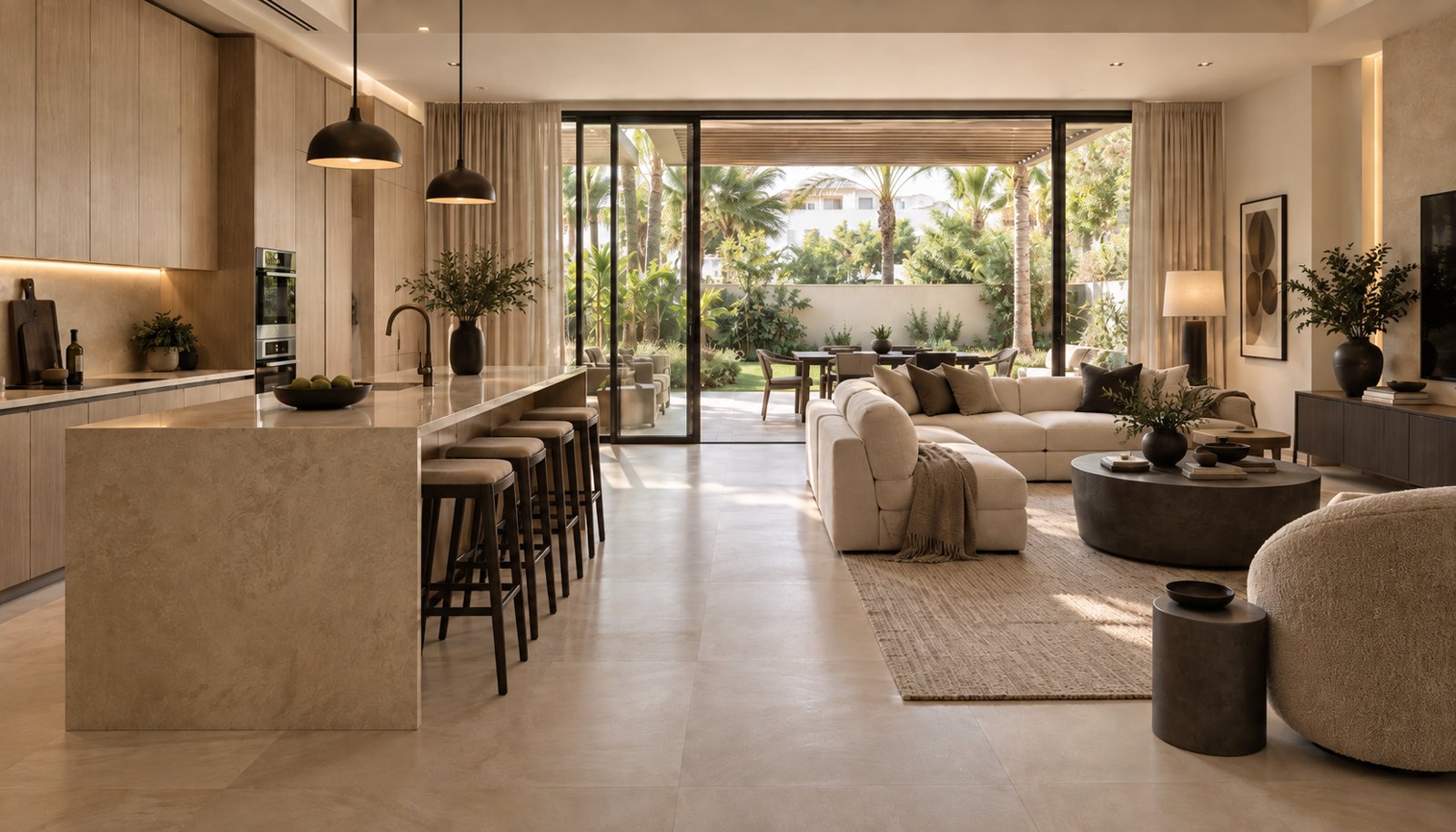
A developer layout is designed to suit every buyer. That is exactly why, a few years in, it rarely suits the one family actually living in it.
Emaar launched Arabian Ranches 3 in 2019, and the community now counts more than 4,000 homes across its gated sub-communities. The first of them, Sun, began handing over in 2022. Several more phases have been completed since, while others are still being built.
That makes Arabian Ranches 3 two communities at once. Newer phases are still in handover and snagging mode. The earlier ones have moved past it: the defects have been closed, the family has settled in, and the list of things that do not quite work has become clear. This guide is for the second group.
Which Arabian Ranches 3 homes this covers
Most of the community is townhouses, and most of this guide is about them.
- Townhouse sub-communities — Sun, Joy, Spring, Bliss, Ruba, and the later May, Raya and Anya phases. Three and four bedrooms. In Sun, the original floor plans run from around 1,940 sq ft for a three-bedroom to around 2,450 sq ft for a four-bedroom.
- Villa sub-communities — Caya, June and Elie Saab, with three to five bedrooms. The priorities below apply here too; the villas simply have more room to work with.
Because every sub-community repeats a small number of house types, most owners are working with a layout that hundreds of neighbours share. That turns out to matter, both for design and for resale.
What Emaar’s community rules allow
Arabian Ranches 3 is managed by Emaar Community Management, and its rules shape what a renovation can include before any design starts.
- Interior painting and routine maintenance do not need a NOC. Contractors still need entry permits to work inside the community.
- Alterations, pergolas and pool works need a Home Modifications NOC, applied for through the community portal.
- The exterior of the house cannot be changed. The facade is part of the community’s look and stays as built.
- External lighting on the house and boundary walls is not allowed under the community rules.
In practice, that places almost all of the opportunity inside the house and in the garden, not on its face. How the Emaar approval route runs, with its fees and deposits, is set out in how renovation permits and NOCs actually work in Dubai.
If anything from the original handover is still open with the developer — a leak, a cracked tile, a fault in the AC — close it before a contractor touches that area. Once the work is redone by someone else, the original defect is much harder to claim.
What to change first
Owners who have lived in a townhouse for a few years tend to arrive at the same list, in roughly the same order.
- The kitchen. A developer kitchen is built to look good at handover and to suit any buyer. Daily family cooking is a different job: more tall storage, a proper pantry, room for the appliances the family actually uses, worktops that take real wear, and lighting over the surfaces where the work happens.
- Storage throughout the house. Full-height wardrobes, a real utility area, and use of the awkward spaces under the stairs and on landings. In a townhouse, storage is usually the single biggest gap between the plan and the way the family lives.
- Lighting. Replacing a grid of standard ceiling fittings with layered light — general, task and accent — changes how the ground floor feels in the evening more than almost anything else on this list.
- Floors that run through. One continuous floor across the ground level makes a compact plan read as one space instead of a sequence of rooms.
- Bathrooms. Usually later in the order, unless waterproofing or drainage is already giving trouble. When they are done, they are best done properly: waterproofing and pipework first, finishes second.
- AC and air quality. After a few summers, owners know which rooms never cool properly. Fixing that belongs inside the renovation, while ceilings are open, not after it. More on this in why your air conditioning might be costing you more than it should.
- The garden and terrace. Shade, planting, outdoor lighting at ground level and a usable outdoor living area. Anything structural, such as a pergola, goes through the NOC first.
Working in a townhouse is different from working in a villa
A townhouse shares walls with its neighbours and a street with the whole cluster. That changes how a renovation has to be run.
- The neighbours are close. Noise, dust and deliveries are felt next door. Demolition is best planned in short, intense phases rather than spread across weeks.
- Access is controlled. Every worker and every vehicle needs an entry permit, and the community sets the rules on contractor access. A contractor who has not worked in the community before learns this on your schedule.
- Space on site is limited. There is little room to store materials, so deliveries need to arrive in the order they are used.
- Shared walls limit what can move. Some walls cannot be touched, and services run where they run. What can change is confirmed on site, before the design is finalised, not after.
Three levels of scope
Most Arabian Ranches 3 projects fall into one of three shapes:
A focused upgrade
Kitchen, storage and lighting on the ground floor. The fastest route to the biggest change in daily life, and the one most townhouse owners start with.
The whole interior
Every floor, one design: kitchen, bathrooms, joinery, flooring, lighting and AC improvements. More work at once, but one period of disruption instead of several.
Interior plus outdoor living
Everything in B, with the garden and terrace designed as part of the house rather than as a separate project afterwards.
What each level costs depends on the specification, and the logic of how a villa budget divides between rooms is set out in what a villa renovation actually costs in Dubai.
If you plan to sell
Repeated house types make one thing unusually easy in Arabian Ranches 3: comparing like with like. The same townhouse is on the market both in original condition and renovated, often in the same cluster. If the gap between those prices is clearly larger than the cost of the work, a renovation before sale is a business case. If it is not, presentation beats renovation. The full reasoning is in renovate before you sell in Dubai.
Before the first quote
- Know your house type. Sub-community, number of bedrooms, and whether it is a middle or end unit.
- Write down what does not work. A few years of living in the house is the best brief there is.
- Close any open defects with the developer first.
- Separate what needs a NOC from what does not, so the approval runs in parallel with the design instead of after it.
- Decide how long the house can be empty, or which floors the family can live on while work continues.
How a full renovation runs once it starts is set out in how a villa renovation in Dubai actually runs, week by week.