How renovation permits and NOCs actually work in Dubai
There is no single renovation permit in Dubai. Which chain of approvals you are in was decided by whoever developed your community.
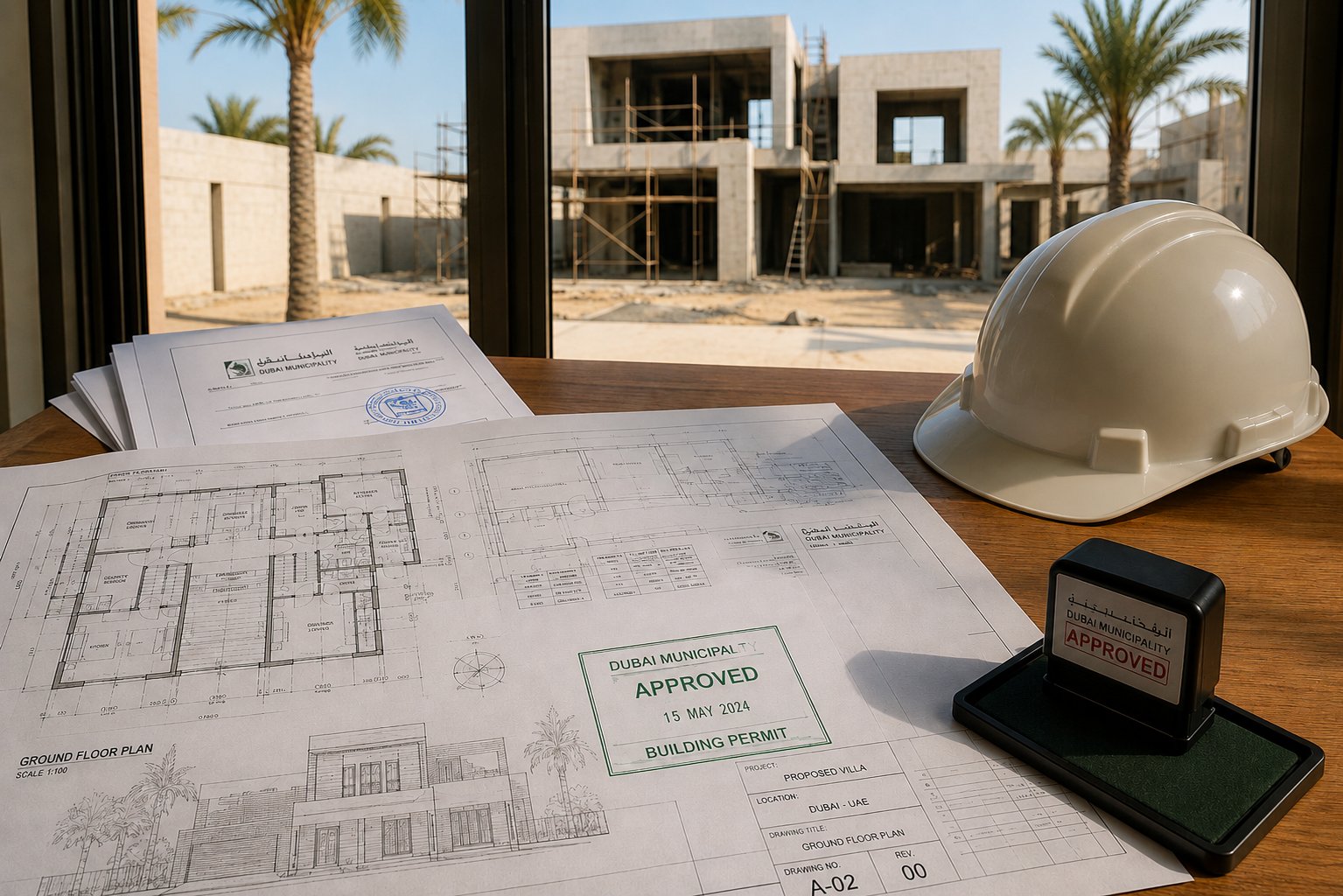
Ask five villa owners in Dubai how they got their renovation approved and you will get five different answers. All five can be correct — they simply live in different communities.
There is no single renovation permit here. There is a chain, and which chain you are in was set years ago by whoever developed the ground under your house. Getting that wrong at the start is how a project loses a month before it has begun.
Three systems, not one
For villas, approvals fall into three broad routes. Apartments follow a fourth, covered further down.
- Emaar communities — Arabian Ranches, Dubai Hills, Emirates Hills, The Springs, The Meadows, The Lakes, The Views. Submissions go through Emaar's own community portal before anything else happens.
- Nakheel communities — Palm Jumeirah, Jumeirah Islands, Al Furjan, and the villa plots in JVC and JVT. Two approvals in sequence: a Nakheel NOC, then a Trakhees permit.
- Mainland plots — Jumeirah, Umm Suqeim, Al Wasl, Al Safa and similar. No developer layer at all; the application goes straight to Dubai Municipality.
Everything else — timelines, fees, what drawings are required, what you are allowed to build — follows from which of those three you are in.
Emaar communities
Applications run through the Emaar community portal, with a modest non-refundable application fee and a refundable security deposit that is typically somewhere between AED 3,000 and AED 10,000, returned once the works are signed off and the community is left as it was found.
A full renovation usually clears in five to nine weeks. Note that a Design Review Committee now looks at all structural and external modifications rather than only large ones, which adds roughly a week to two to the process. Extensions carry their own additional charge based on the added area, and it is materially higher in the premium communities.
The security deposit is not a formality. It is refundable, but it is also the community's leverage over noise, working hours, waste and damage to shared roads and kerbs during your project.
Nakheel and Trakhees
This is the two-step route, and the step people forget is the second one. A Nakheel NOC comes first; the structural permit then comes from Trakhees, and the drawings must be prepared in the format Trakhees expects rather than a generic set. Deposits here run higher, commonly AED 5,000 to AED 20,000, and the process realistically takes six to ten weeks.
Palm Jumeirah carries extra requirements of its own — ground investigation for anything structural, restrictions on what may be built above the parapet line, and wind-load analysis on larger structures. None of it is difficult if it is planned for. All of it is expensive if it is discovered late.
Mainland villas
Without a master developer in the middle, this is the shortest route: straight to Dubai Municipality's building permit system, typically four to seven weeks. The authority fee is calculated on built-up area rather than charged flat, and for a normal villa it is a modest line in the budget.
What mainland submissions do require is a properly registered consultant. Drawings must be stamped, the current affection plan must be attached, and larger extensions bring sustainability requirements with them. There is less waiting, but less tolerance for an incomplete file.
Apartments follow a different route entirely
Here the first gate is not an authority at all — it is building management. Any work that touches access, lifts, corridors, noise, waterproofing, balconies, fire systems or shared services needs their NOC, and they will ask for the contractor's licence, insurance, method statement and a fit-out deposit before issuing it.
On top of that sits the authority permit, and which authority depends on where the building stands. In areas under the Dubai Development Authority there is a fit-out permit for works and a separate maintenance permit for lighter work, each with its own validity period and fee, and choosing the wrong category is a non-refundable mistake. Elsewhere the route is Dubai Municipality or the relevant free-zone authority.
Three things reliably cause trouble in apartments:
- Wet areas. Moving a bathroom or kitchen means waterproofing, drainage and risers that belong to the whole building, not to your unit.
- Drilling and demolition. Slabs are post-tensioned. There are hard limits on how close a penetration may come to a column and what may be cut at all, and they are not negotiable.
- Anything visible from outside. Balcony glazing, external units, facade changes — refused as a matter of course without specific approval.
What every application asks for
The file differs in detail between routes, but the core is consistent:
- Title deed and the owner's Emirates ID — and the landlord's written consent if you are a tenant
- The contractor's DED trade licence, with the right activity actually listed on it
- The contractor's third-party liability insurance, valid on the day of submission
- Drawings appropriate to the scope, stamped by a registered consultant where structure is involved
- A written scope of works and photographs of the current condition
If a contractor cannot produce the first three from their own file within a day, that is worth knowing before you sign anything.
The clock, and what can run alongside what
Approvals are not the long pole in a renovation, but they are the one that cannot be compressed by paying more. Design and a locked scope take four to eight weeks. Approvals take four to eight weeks. Long-lead materials take eight to twelve.
The useful part is that all three overlap. Approvals can be lodged while material selections are being finalised, and orders can be placed while the file is with the authority. Run in sequence, the same project starts three months later than it needed to.
What skipping it costs
Unpermitted work is not a technicality that gets quietly forgiven. In the master communities it means a fine and, more painfully, a hold that surfaces when the property is sold or transferred. In the Nakheel communities it can mean a stop order, a forfeited deposit and a contractor blocked from future applications. On the mainland it is a fine for the first offence and a further daily charge for every day the work continues.
The pattern is consistent: the cost of doing it properly is a few thousand dirhams and a few weeks. The cost of not doing it arrives years later, at the worst possible moment, usually at a title transfer.
Whose job this is
Not yours. A competent contractor handles the submission, the community coordination, the inspections and the completion certificate as part of the scope, and says so in writing before the contract is signed. If approvals appear as a separate item to be dealt with by the owner, that tells you something about how the rest of the project will be run.
Fees, timelines and community rules change — the figures above are current market practice rather than a legal reference. Before you budget, have them confirmed for your specific property and community.
How these routes play out in specific communities is set out in villa renovation on Palm Jumeirah, renovating a home in Dubai Hills Estate and the Arabian Ranches 3 renovation guide.