How to choose a reliable renovation company in Dubai
The wrong contractor is the single most expensive decision in a renovation. Here is how to tell them apart before you sign.
Almost every renovation horror story in Dubai traces back to the same root cause — the wrong company was chosen, for the wrong reasons, before anything was verified.
Dubai has one of the busiest renovation markets in the world, and with it, an enormous range in quality. The gap between a company that finishes on time and one that leaves you chasing them through the summer is not visible in a glossy portfolio. It shows up in the paperwork, the contract, and the questions they can answer on the spot.
This is what to actually check — in the order that protects you most.
Start with the licence, not the Instagram
A strong portfolio tells you a company can photograph a finished room. It tells you nothing about whether they are legally allowed to build one. Before anything else, confirm two things exist and are current.
- A DED trade licence from Dubai's Department of Economic Development, with renovation or fit-out activity actually listed on it — not a licence for something adjacent.
- Contractor liability insurance that is valid today, not lapsed. Ask for the certificate and check the date.
A company that hesitates, delays, or talks around either of these has told you everything you need to know. Reputable firms hand them over without being chased.
For work in developer communities, your contractor also needs to be familiar with approvals from bodies like Dubai Municipality, and with developers such as Emaar and DAMAC. An unapproved contractor can stall a project for weeks waiting on permissions.
Insist on a real scope, not a single number
The most dangerous quote is the cheapest one, because the cheapest one is usually the one that left the most out. A single headline figure — "full villa renovation, AED X" — is not something you can hold anyone to.
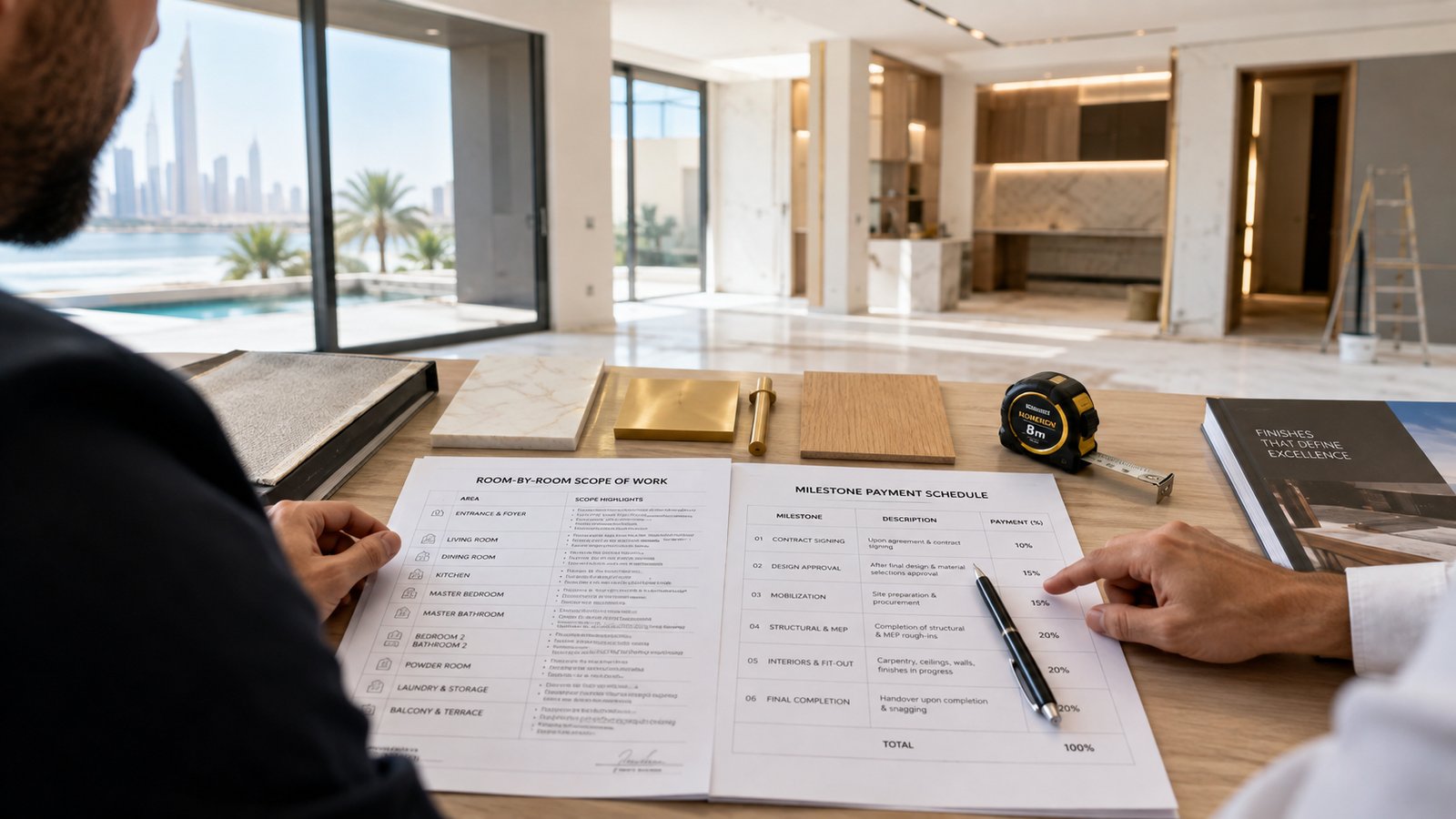
What you want instead is a line-by-line breakdown: rooms, materials, brands, quantities, and crucially, exclusions. When every item is named, two things happen. You can compare quotes on equal terms, and there is far less room for a "variation order" to appear later at a price set with no competition.
If two companies are AED 200,000 apart, it is almost never that one is generous and one is greedy. It is that they have quietly quoted two different projects.
Tie payment to progress, not to the calendar
Never pay in full upfront, and be cautious of anyone who asks for more than a third before work begins. A healthy contract ties each payment to a completed, verifiable stage of the job rather than to a date.
A typical structure looks like a deposit to start, a payment at structural or first-fix completion, another at fit-out, and a final portion held back until snagging is signed off. That final retention matters more than people realise — it is the leverage that gets the last five per cent finished properly.
Ask who is actually accountable
Two questions separate a coordinated company from a loose collection of subcontractors:
- Who is my single point of contact? You want one named project manager who owns the outcome — not a different number for tiles, plumbing and electrics.
- Who is on site, and who do they work for? Companies with direct in-house trades, or a stable set of trusted subcontractors, control quality and pace far better than those assembling a new crew for every job.
Bundled accountability is not a luxury. When civil, MEP and HVAC sit under one company, there is no gap for problems to fall into and no one to point at but the firm you hired.
Trust visited references over written ones
Testimonials on a company's own website are marketing. What you want is a recent, local, completed project you can actually visit, or at minimum a client you can speak to directly. Reviews on independent platforms carry more weight than anything self-published.
Ask specifically for a project of a similar type to yours. A firm brilliant at retail fit-outs is not automatically the right choice for a villa, and vice versa.
Six questions to ask before you sign
If a company answers these clearly and without discomfort, you are likely in good hands:
- Are you licensed for renovation work and currently insured — and may I see both?
- Will you handle all permits, NOCs, inspections and community approvals yourselves?
- Can you give me a line-by-line scope and a milestone-based payment schedule?
- Who will be my single project manager, and who supervises the site day to day?
- Can I visit a recent, comparable project you have completed nearby?
- What warranty and after-completion support do you provide?
None of this is about being difficult. A serious company expects these questions and is relieved to be dealing with a client who asks them — because it means the relationship starts on clear terms, which is exactly how a good renovation stays on track.
Before comparing companies, it helps to know what a complete quotation should contain — that is in what turnkey actually includes in a Dubai renovation — and which approvals the contractor is expected to handle, in how renovation permits and NOCs actually work in Dubai.