What turnkey actually includes in a Dubai renovation
The word has no fixed meaning here. Two companies can both call their offer turnkey and be quoting projects AED 200,000 apart.
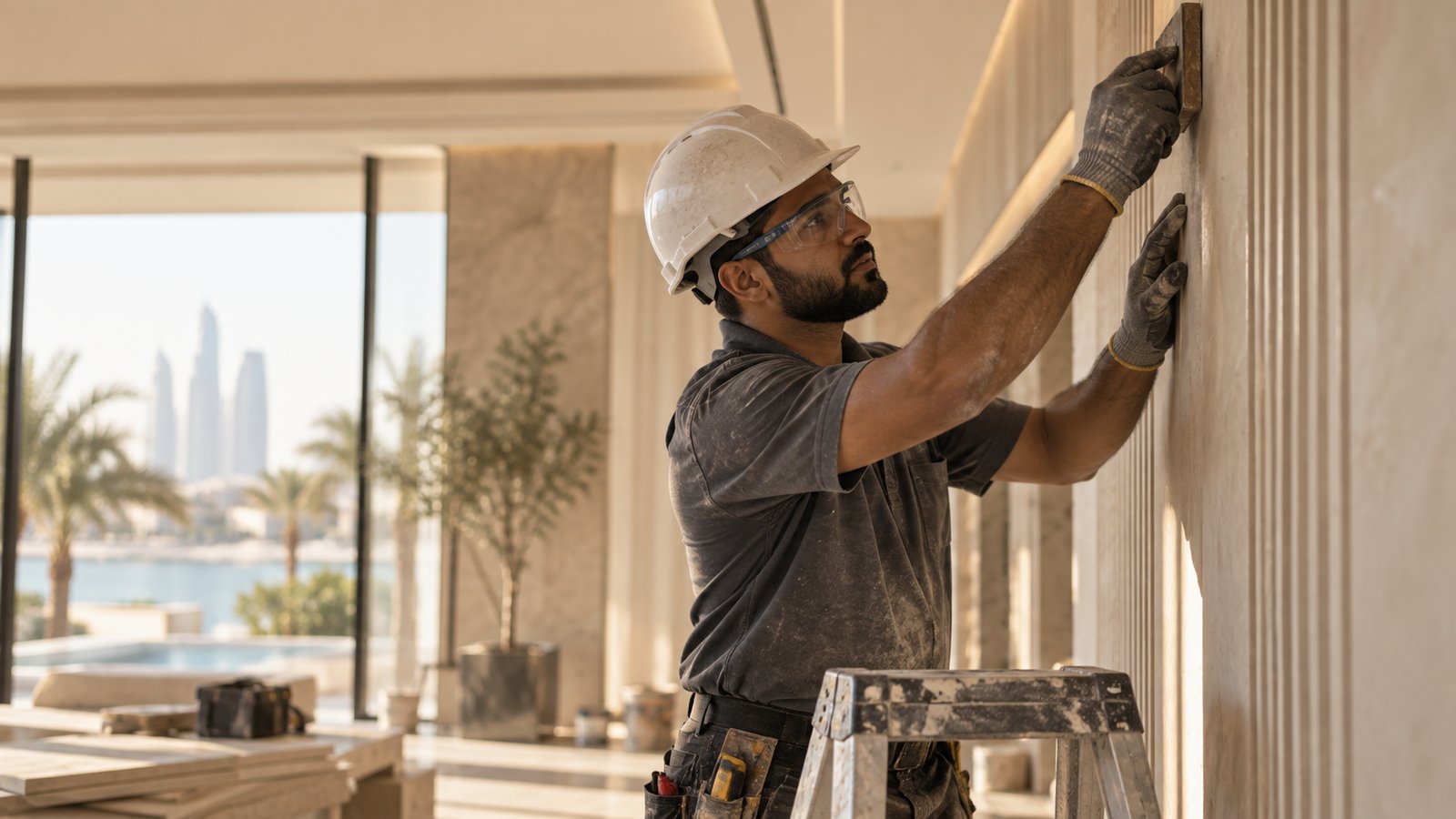
Turnkey is not a specification. It is a promise about who does the coordinating — and in Dubai it is used by companies whose scopes differ by a third of the budget.
Three companies quote a villa. All three say turnkey. One is AED 320,000, one is AED 480,000, one is AED 610,000. The instinct is to assume the middle one is sensible and the cheapest one is cutting corners on quality.
Usually that is wrong. The gap is rarely quality. It is what each of them decided the word covers.
The word has no standard
In practice, three different delivery models circulate under the same label.
- Genuine turnkey, or design-and-build. One contract covering design, drawings, approvals, procurement, construction and handover. One company owns the programme and has nobody to blame.
- Main contractor on somebody else's design. They build what has already been drawn and specified. Design fees, consultant coordination and often the approvals sit with you.
- Supply-and-fix, or supply only. They deliver and install their part — joinery, stone, MEP — and the sequencing between trades is somebody's problem, usually yours.
None of the three is wrong. Choosing one without knowing which you are looking at is what goes wrong.
The items that sit on the boundary
These are the lines that get read as included by the client and excluded by the contractor. Every one of them has produced an awkward conversation on a real project.
Before site
- Design, drawings and revisions — and how many rounds of changes are covered before they become chargeable
- Structural or MEP consultant sign-off where anything load-bearing or wet moves
- Authority permits, community NOCs and submission fees
- Refundable community deposits — who lodges them, and who chases them back
During the works
- MEP: new or as existing. The single biggest hidden variable. A quote based on retaining existing wiring and pipework is not comparable to one that renews it.
- Joinery: manufactured or bought in. Affects lead time, fit and who returns to adjust a door in month eight.
- Sanitaryware, taps, ironmongery and appliances — supplied by them, or by you against an allowance
- Waste removal, community charges, temporary power and water, site insurance
At the end
- Making good — the damage that construction does to whatever was staying
- Deep clean as distinct from a builder's clean, which is sweeping
- Snagging and the defects period — how long, and on what: workmanship, or equipment too
- As-built drawings and warranty documents handed over, so the next contractor is not guessing
Outside the walls
- Landscaping, pool, facade and external paint
- Curtains, blinds, loose furniture, AV equipment, light fittings as opposed to the wiring for them
Light fittings and lighting infrastructure are two different line items. A quote can include every circuit, driver and aperture in the house and not a single pendant.
What each gap costs when it turns up later
An exclusion is not free. It is a payment you make in month four instead of month one, at a price nobody is competing for. Rough market figures for the most common ones:
- Permits and NOCs — a Dubai Municipality permit commonly runs a few thousand dirhams, a developer NOC a similar order, plus DEWA approvals
- Community deposits — typically AED 3,000 to 10,000 in Emaar communities, AED 5,000 to 20,000 in Nakheel ones
- Full MEP renewal instead of retained — AED 60,000 to 120,000 on a villa
- Appliances and sanitaryware — easily AED 40,000 to 100,000 across a four-bedroom house at premium level
- Landscaping — AED 30,000 to 100,000; a pool, AED 55,000 to 200,000
- Curtains, blinds and loose furniture — routinely the largest single surprise, because nobody prices it until the house is finished and empty
Add the plausible ones together and the cheapest of those three quotes stops being the cheapest.
The words that mean not yet priced
Watch for provisional sum, allowance, budget figure, subject to site conditions and to be confirmed. None of them are dishonest — some things genuinely cannot be fixed before a wall is opened. But each one is a number that will move, and only in one direction.
The question worth asking is not whether a quote contains provisional sums. It is how many, how large as a share of the total, and what will settle them.
Five questions that settle it
Different from the questions that tell you whether a company is credible — those are set out in the piece on how to choose a renovation company. These are only about the boundary of the scope, and all five have yes-or-no answers:
- Is the MEP in this price new, or retained as existing?
- Are the permits, NOCs and community deposits inside this figure or outside it?
- Does the price include sanitaryware, taps, ironmongery and appliances, or an allowance for them?
- Which of these lines are provisional sums, and what percentage of the total do they represent?
- What is the defects period, what does it cover, and is it workmanship only or equipment as well?
A company running a genuine turnkey model answers all five in one email. If the answers arrive as a phone call rather than in writing, that is the answer.
Which model suits which project
If there is already an interior designer with drawings and a specification, a main contractor is the sensible appointment — paying a turnkey provider to redo design work that exists is waste.
If the starting point is an empty villa and a vague idea, turnkey earns its keep. Not because it is cheaper, but because the gaps between design, procurement, joinery and construction are where programmes leak, and under one contract there are no gaps to leak through.
Either way, the decision is made by comparing like for like. Two quotes are only comparable when both have answered the same five questions, and a headline figure has never answered any of them. The ways that goes wrong in practice are collected in 10 costly mistakes that blow up a renovation budget.