Why two identical Dubai apartments cost different amounts to renovate
Same size, same specification, same contractor — and a gap of tens of thousands between the two quotes. The difference is the building, not the flat.
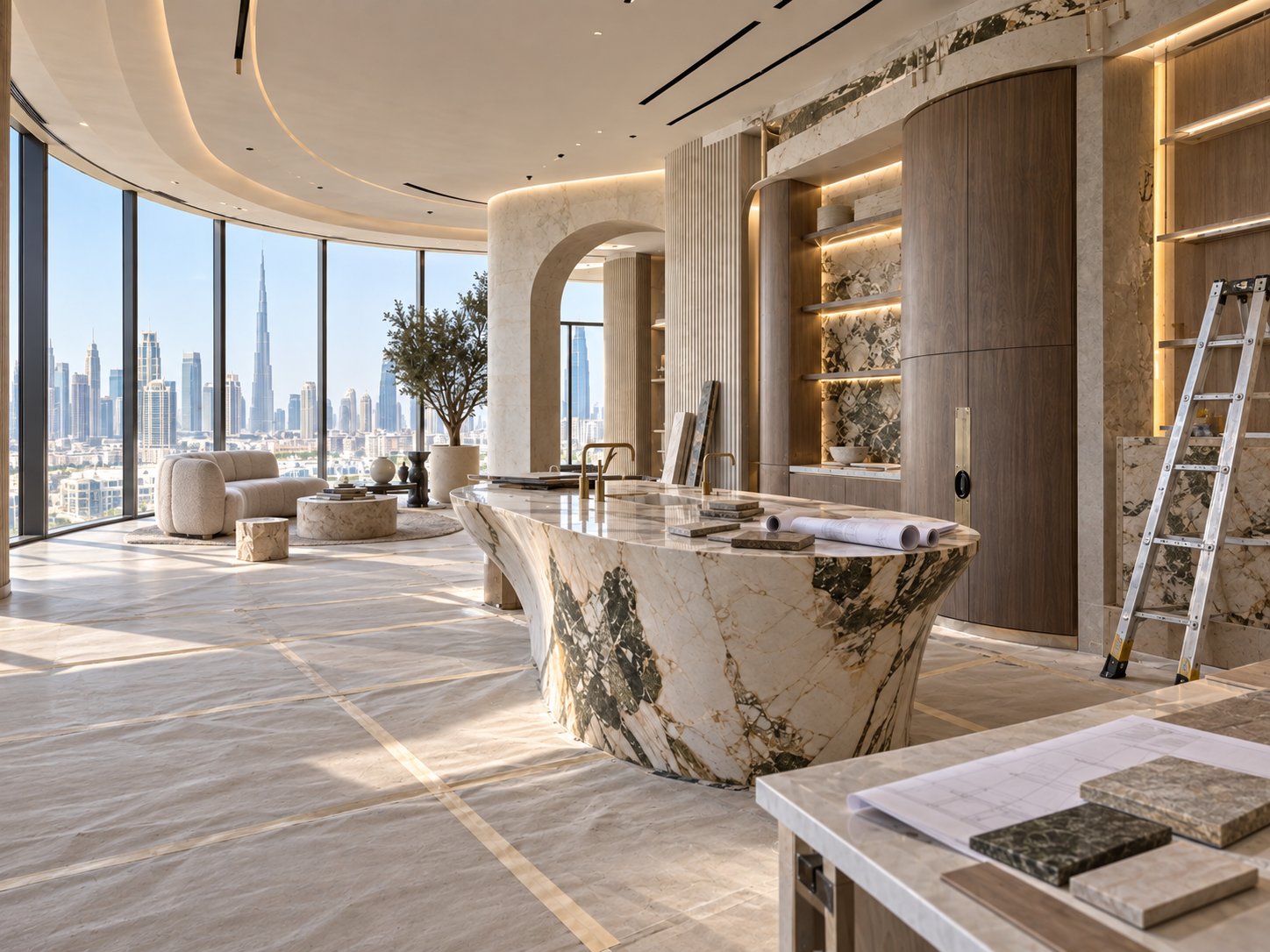
Two identical two-bedroom flats. Same area, same specification, same contractor. One quote comes back materially higher — and the reason is the service lift.
A villa budget is driven by scope: how much of the house gets touched and to what standard. Apartments are different. The scope still matters, but a second set of costs sits on top of it — costs that have nothing to do with your flat and everything to do with the tower it sits in.
Nobody quotes those costs in a brochure, and they are the reason two apartment quotes for the same job are so often impossible to line up.
The starting figures
For orientation only, before anything specific to your building:
- Light refresh, studio or one-bed — AED 25,000 to 60,000
- Targeted upgrade, one or two beds — AED 60,000 to 180,000
- Full renovation, two or three beds — AED 120,000 to 320,000
- Premium standard, larger apartment — AED 250,000 to 400,000 and upwards
- Penthouse standard — AED 350,000 to 600,000 and upwards
Note what is missing: a rate per square foot. Villas are priced that way and apartments largely are not, because two flats of identical area in different towers are not the same job. How the money divides between rooms follows the same pattern as a villa, and that is set out in what a villa renovation actually costs in Dubai.
The building sets more of the price than the floor area does
Six things, in rough order of how much they move the figure:
- The service lift. Every kilogram in and out of your flat moves through one booking. A tower that gives a contractor the lift for a full day is materially cheaper to work in than one that offers a morning slot.
- Working hours. Set by the building, and tighter on Fridays and through Ramadan. Fewer productive hours is more days for identical work.
- Protecting the common areas. Lift cars, corridors, lobby floors, and reinstating anything marked. A real line item — and the one where deposits get withheld.
- Waste removal. Many towers mandate their own contractor or a specific route out. You pay their rate rather than the market rate.
- Worker passes and security registration. Every person entering, sometimes charged per head.
- The security deposit. Held by building management, returned only if the building is left as it was found.
Ask which lift slot your building gives before asking anything about materials. The answer sets the programme, and the programme sets the price.
These have a name, and cheap quotes leave them out
All of the above belongs in a section of a proper quotation called preliminaries — the cost of being able to work at all, as distinct from the cost of the work itself.
An apartment quote that looks unusually low is rarely cheaper at the finishes. It carries close to nothing for preliminaries. Those costs do not disappear; they arrive later as extras, once the building starts enforcing its own rules. Which items belong inside a quoted figure and which sit outside it is the subject of what turnkey actually includes in a Dubai renovation.
One flat, two towers
The clearest way to see it. Identical two-bedroom apartments, identical scope: kitchen replaced, two bathrooms renewed, flooring throughout, wardrobes, repaint, new lighting. Same contractor, same specification, same materials.
Service lift for a full day, six working days a week
Deliveries land in one trip. Demolition waste leaves in two. Trades overlap because material is on the floor when they arrive. Nine weeks on site.
Morning lift slot, no work on Fridays, waste through the building's own contractor
The same deliveries take three bookings across two weeks. Stone arrives after the tiler. Waste leaves on the building's schedule, not the programme's. Thirteen weeks on site.
Four extra weeks, and none of them buy anything. They land in site supervision, repeated lift bookings, protection that stays down longer, passes for a longer period, and a crew standing on a floor waiting for material that is downstairs.
That is the gap between the two quotes. Not the tiles.
Permits and fees
Modest against the build cost, but they belong in the figure rather than arriving as a surprise. In buildings under the Dubai Development Authority a fit-out permit is charged on area — in the region of AED 0.90 per square foot, with a floor of AED 200 and a cap of AED 10,000 — and a lighter maintenance permit exists for smaller work. Picking the wrong category is a non-refundable mistake. Elsewhere the route runs through Dubai Municipality or the relevant free-zone authority.
Which authority covers your tower, and what the building's own NOC requires, is in how renovation permits and NOCs actually work in Dubai.
What money cannot buy
Some answers are not a budget question. Drainage that needs a fall into a riser you do not own, a slab that cannot be cut, a kitchen extract with no route outside, a balcony that cannot be enclosed. No figure changes any of them, which is why feasibility comes before pricing — see what the building decides in your Dubai apartment renovation.
When the clock actually starts
- Cosmetic refresh — one to three weeks
- Kitchen or bathrooms — three to eight weeks, depending on materials and waterproofing
- Full one or two-bed — six to twelve weeks for most scopes
- Full apartment at premium standard, or a penthouse — twelve to twenty-four weeks and beyond
Every one of those clocks starts at access approval, not at signature. The building's paperwork sits in front of the programme rather than alongside it, and a contractor who has worked in your tower before knows how long that takes. One who has not will find out on your project.
The figures here are current market ranges rather than a quotation. What your apartment costs depends on your building — which is why the answer starts with somebody walking it.