Bathroom renovation in Dubai: the five decisions that make or break it
Bathrooms are the most expensive room per square metre and the least forgiving. Most of the cost and almost all of the risk sit in five decisions made before the first tile arrives.
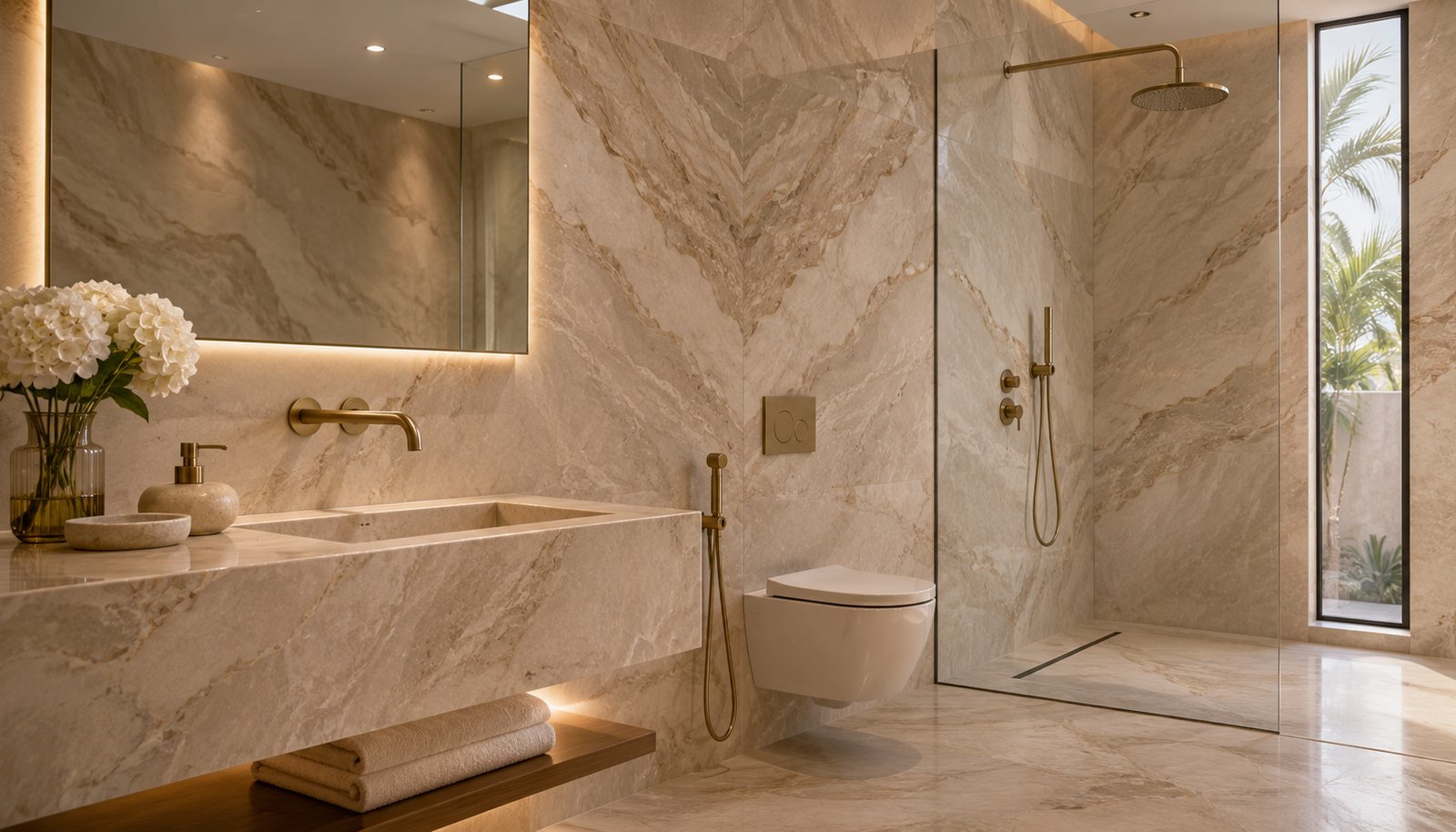
A bathroom is the only room in a renovation where the most important work is the part nobody will ever see again.
Bathrooms are small, and that makes people underestimate them. Per square metre they are the most expensive room in almost any Dubai renovation, and they are the room where a mistake is least forgiving: a kitchen that was planned badly is annoying, a bathroom that was waterproofed badly is a second renovation.
Most of the cost and almost all of the risk sit in five decisions, and four of them are made before a single tile arrives on site.
Why a small room costs so much
Every trade in the project passes through a bathroom. Demolition, drainage, water supply, electrics, extract ventilation, waterproofing, screed, tiling, stone, joinery for the vanity, glass for the shower, sanitaryware, sealant, and then a second visit from half of them to connect what the first visit left. In a bedroom the same area needs plaster, paint and a socket.
That is also why the sequence matters more here than anywhere else. Each trade closes the wall behind it for the next one. Change your mind about a shower niche after the waterproofing is done and you are not editing a drawing, you are reopening a sealed surface.
Decide the full specification of a bathroom before demolition starts, down to the position of the shower mixer and the width of the niche. In a bathroom, late decisions are not a delay. They are rework.
Decision one: whether you move the water
This is the fork that sets the budget. Keeping the toilet, basin and shower roughly where they are means working with existing drainage falls and existing risers. Moving them means new falls, new chases, sometimes a raised floor, and in an apartment it means a conversation with the building before anything else.
Drainage runs on gravity, which is the part most layout ideas forget. A toilet moved a few metres from its stack needs enough fall to drain reliably, and the floor has to find that height somewhere. In a villa there is often room to do it properly. In an apartment slab there frequently is not, and the honest answer is that the toilet stays where it is.
In a building, the layout is not purely your decision either. Wet areas sit above other people's ceilings, and most communities and developers restrict what can be moved for exactly that reason. We wrote about where that line usually falls in what the building decides in your Dubai apartment renovation, and about the approval route in how renovation permits and NOCs actually work.
What this decision is worth knowing before you fall in love with a plan: a bathroom that keeps its wet points and changes everything else can look completely new. A bathroom that relocates them is a different project with a different price.
Decision two: the waterproofing you will never see again
Waterproofing is the one element of a bathroom that cannot be inspected after the fact, cannot be improved later, and cannot be patched from the outside. It goes in, it gets covered in screed and tile, and either it was done properly or you find out months later in the room next door.
What proper looks like, in plain terms:
- The whole wet zone, not just the floor. Shower walls to full height, the floor across its entire area, and the junction between them, which is where failures actually start.
- Corners and penetrations treated separately. Floor-to-wall corners, pipe entries, the drain body and the door threshold get reinforcing tape or a bonded collar. A membrane is only as good as its weakest joint.
- The right number of coats, with drying time between them. Membranes have a specification. Rushing coats to save two days is a quiet way to lose the job.
- A flood test before anything is laid on top. The drain is plugged, the floor is filled, the level is marked, and it is left overnight. If the level drops, the membrane failed and it is still cheap to fix.
That last point is the one worth insisting on, because it is the only moment when the invisible work becomes visible. Ask for the flood test to be photographed with the date, and keep the photo. It belongs in the handover pack along with everything else we list in what a renovation warranty actually covers.
Decision three: how the room gets rid of moisture
Most Dubai bathrooms have no window. The room is sealed, it is used hot, and the only way the moisture leaves is through a duct and a fan. When that fan is undersized, badly ducted, or wired to the light switch so it runs for ninety seconds, the moisture stays. Then it shows up as mould in the silicone, swollen joinery, lifting paint on the ceiling and a smell that cleaning does not fix.
This is a cheap thing to get right and an expensive thing to live with. What it takes is an extract fan sized for the room rather than whatever fits the hole, a duct that actually reaches outside instead of ending in the ceiling void, and a run-on timer or humidity sensor so the fan keeps working after the room is empty.
Joinery choices follow from the same logic. A vanity in a sealed, humid room is not the same product as a vanity in a dressing room, and the difference is in the carcass material and the edge sealing rather than in the door you see.
If an existing bathroom smells damp or the silicone keeps going black, the problem is usually ventilation, not cleaning. Fixing it during the renovation costs very little. Fixing it afterwards means opening a ceiling.
Decision four: the stone, and how it is cut
This is where the look of the room is decided, and where the budget quietly doubles. The same bathroom finished in large-format porcelain and finished in book-matched marble is the same layout, the same labour sequence and a very different invoice.
The variables that move the number:
- Material. Porcelain, engineered stone and natural marble sit at different levels, and within marble the range is enormous.
- Format. Large slabs mean fewer joints and a calmer room, but they also mean heavier handling, more waste, and skilled cutting on site.
- Pattern work. Book-matching, vein continuation across a corner, a slab carried from floor to wall into the shower. All of it is beautiful and all of it is paid for in cutting, wastage and labour hours.
- Edges and details. Mitred edges, shadow gaps, an integrated stone basin, a niche cut from the same slab. Small items, large time.
- Maintenance. Natural stone in a shower needs sealing and a cleaning routine. It is worth knowing that before choosing, not after.
None of these is the wrong choice. The mistake is choosing the pattern work and then discovering the price, rather than setting the budget and then choosing how to spend it.
Decision five: the fittings, and what the water does to them
Dubai's mains supply is largely desalinated and is widely reported as hard. Whatever the exact figures in your community, the practical effect is familiar to anyone who has lived here: limescale on glass, spotting on chrome, and tap aerators that clog. It is worth choosing fittings and finishes with that in mind.
In practice that means a few things. Solid brass bodies rather than light alloy. Finishes that tolerate being wiped daily, which is why brushed and satin finishes forgive more than polished ones and why matte black shows every drop. Shower glass that has been treated, or accepted as something that needs squeegeeing. And brands with a service presence in the UAE, because the question that matters three years from now is whether a cartridge can be replaced without replacing the whole mixer.
Concealed mixers deserve one specific note. The valve lives inside the wall and the handle you choose is cosmetic. Make sure the body is accessible for service, that it is a model the supplier will still stock, and that the installer records what went in. A concealed valve that cannot be serviced turns a small repair into tile removal.
What actually drives the price
When two bathroom quotes differ, it is almost never the tiling labour. It is this list:
- Whether drainage and water points move.
- Material and format of the stone or tile, and how much pattern work it carries.
- Sanitaryware and brassware level, and whether mixers are exposed or concealed.
- Shower enclosure: standard glass panel, frameless, or a walk-in wet area with a linear drain.
- Underfloor heating, steam, or a bath that needs structural support.
- Joinery: a bought vanity against a made-to-measure one in moisture-rated materials.
- Lighting and electrics, especially if the room is being rewired for layered lighting and mirror circuits.
We have deliberately not put figures in this article. Bathroom numbers in Dubai swing by a factor of several depending on the items above, and a range quoted without a specification is worth nothing. The honest way to price a bathroom is a measured scope with named products. The same logic applies to the rest of the property, which is the subject of what a villa renovation actually costs in Dubai.
The order the work happens in
A bathroom is not built in layers you can reshuffle. Roughly, it runs like this:
Sanitaryware, tiles, screed and old joinery come out, back to the structure. Surprises show up here, and this is the moment to re-check the drainage you planned around.
Drainage, water supply, electrics and the extract duct are installed and tested. Everything that will be buried is positioned now, against a drawing, including the shower mixer height and the niche.
Membrane applied to specification, corners and penetrations reinforced, then tested and photographed before anything covers it.
Falls formed towards the drain, then tile or stone set out from the most visible line in the room rather than from a corner.
Sanitaryware, brassware, joinery, mirrors and lighting go in. Shower glass is measured only after tiling, which is why it usually arrives last.
Silicone lines, door clearances, water pressure and temperature, drainage speed, fan performance. Our full list is in the snagging checklist to run before handover.
The glass is the item that most often sets the finish date, because it cannot be ordered from a drawing. If a bathroom has to be ready by a date, that is the lead time to ask about first.
What to ask before you sign
- Which waterproofing system will be used, how many coats, and will there be a photographed flood test?
- Are the drainage falls achievable without raising the floor, and if the floor rises, by how much?
- What size is the extract fan, where does the duct terminate, and does it have a run-on timer?
- Is the stone being dry-laid and approved before fixing, and who signs off the vein layout?
- Are concealed valves serviceable, and which brand and model is going in?
- What is the lead time on sanitaryware, brassware and shower glass, and what happens to the programme if one item slips?
- Who holds the warranty on the waterproofing, and for how long?
A bathroom that was planned properly looks expensive and behaves quietly. A bathroom that was decided as it went along usually looks fine for a year. The difference is entirely in the five decisions above, and four of them are made before anything looks like a bathroom at all.