Renovating a home in Dubai Hills Estate: what a full renovation actually involves
The earliest homes in Dubai Hills Estate are approaching a decade old. At that age the question is not which room to redo — it is whether to renovate the house as one project.
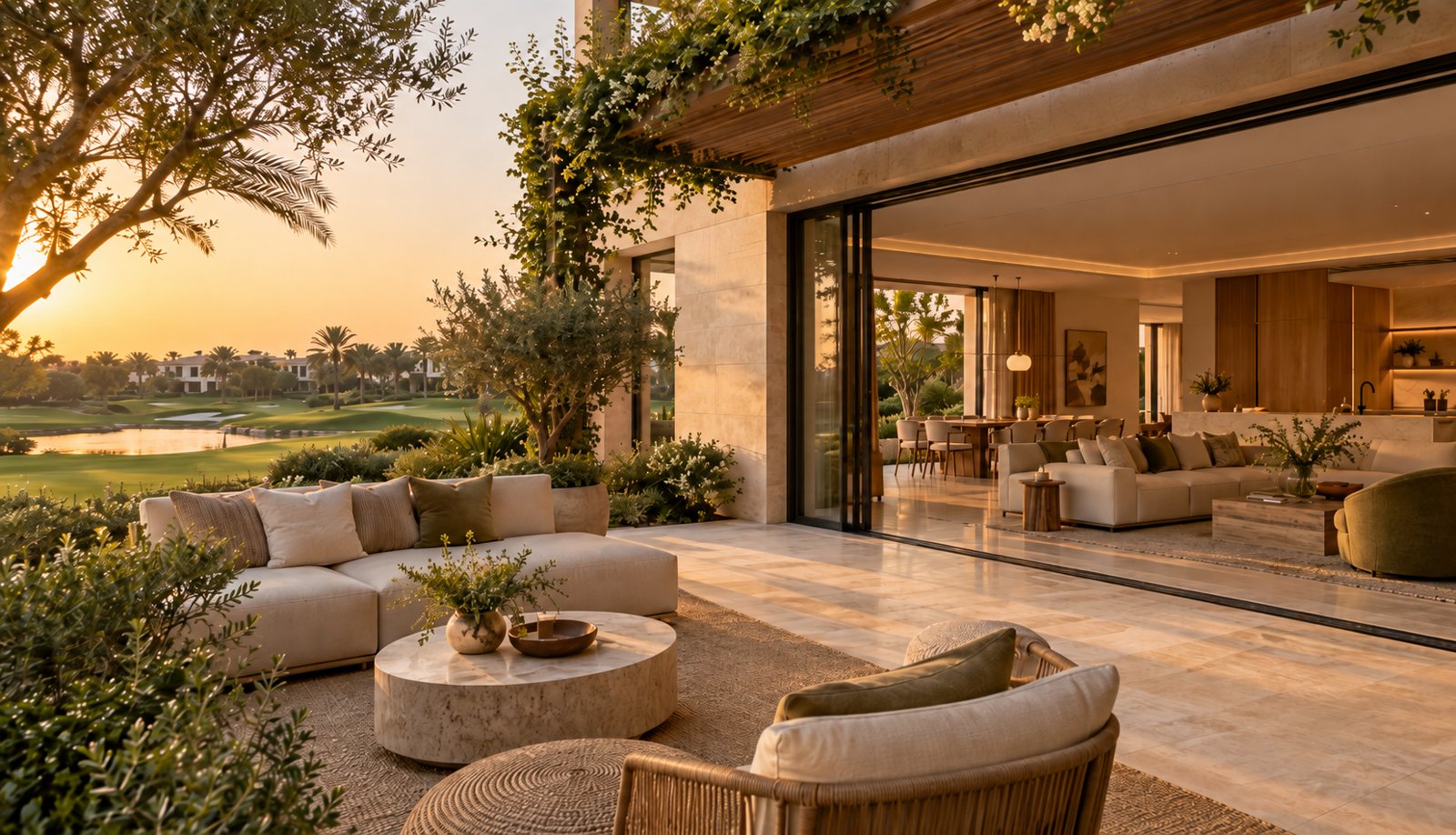
A house that was perfect at handover in 2019 is not failing seven years later. It is a 2019 house, and the family in it has changed since.
Emaar launched Dubai Hills Estate in January 2014 as a joint venture with Meraas. The first villas at Hills Grove were handed over around the middle of 2016, and the main wave followed in 2019: Sidra, Maple, Parkways, Park Heights.
That timing is what makes the community interesting right now. Homes handed over six to ten years ago are past snagging and past small fixes. They reach the point where services, layout and finishes all come due at once — which is a different project from redecorating.
Three property types, one address
Dubai Hills Estate holds three quite different renovation jobs.
- Villas — Hills Grove, Fairways, Club Villas, Parkways and the later villa phases. The most freedom inside the house, the most outdoor space, and the largest scope.
- Townhouses — Sidra 1 to 3 and Maple 1 to 3, handed over from 2019. Shared walls, compact plots, repeated floor plans, tighter site access.
- Apartments — Park Heights, Golf Grove, Golf Place and the newer towers. A full renovation is entirely possible here; it simply begins with the building rather than with the design.
What the community rules fix before anything is drawn
Dubai Hills Estate is managed by Emaar Community Management, and its rules set the outer edge of the scope.
- A Home Modifications NOC is required for villa alterations, and equally for carport extensions, garden pergolas and pool works. Applications go through the community portal.
- The exterior of the villa cannot be changed. Lights may not be installed on top of boundary walls or on their community-facing side.
- Everything beyond the distribution board belongs to the owner, along with the carport and its interlock and the DEWA meter cabinet.
In practice that places almost the entire opportunity inside the house. How the Emaar approval route runs, with its fees and deposits, is set out in how renovation permits and NOCs actually work in Dubai.
The community rules are the cheapest document in the whole project and the one most often read last. An hour spent on them before the design starts is an hour that saves a redesign later.
Why one project beats five separate ones
Owners of homes this age usually consider doing it in stages: the kitchen this year, the bathrooms next, the AC when it finally gives up. On paper that spreads the cost. In practice it raises it.
- The services are opened once. AC, electrics, plumbing and waterproofing all sit above ceilings and behind walls. Opening them for one project costs a fraction of opening them three times.
- The house is disrupted once. One period of moving out, or of living around the work, instead of three.
- The result reads as one house. A new kitchen beside original bathrooms and 2019 flooring makes the untouched rooms look older rather than the new work look newer.
- Nothing is paid for twice. Staged work almost always means removing something that was finished in an earlier stage.
What a full renovation covers in a home of this age
- Layout, within what is permitted. What can move is established first: structure, drainage falls, extract routes, and what the community or the building allows.
- The services. AC, electrical distribution, plumbing, and full waterproofing of every wet area, terrace and roof in scope. In a home approaching ten years this is the part that justifies the project, and it is invisible once finished.
- Kitchen and joinery. The kitchen rebuilt around how the family actually cooks, plus wardrobes, utility space and the awkward corners a developer plan leaves unused.
- Finishes and lighting. One continuous material palette, and a lighting design settled on paper before first fix rather than a grid of identical downlights.
- Outdoor space. Shade, planting and ground-level lighting, with anything structural going through the NOC first.
How the project runs
Approvals run alongside the design rather than after it. Materials are selected early enough to be ordered rather than substituted. In an empty house the trades overlap and the programme is continuous; with the family in residence the same scope takes longer and needs phasing and protection.
Townhouses add community access rules, entry permits for every worker and very little room on site for materials. Apartments add the building: working hours, the service lift, waste routes, protection of common areas and a security deposit — the items that explain why two identical flats receive different quotes, set out in why two identical Dubai apartments cost different amounts to renovate.
Week by week, a full villa renovation is mapped out in how a villa renovation in Dubai actually runs, week by week, and what belongs inside a single quoted figure is in what turnkey actually includes in a Dubai renovation.
Renovate, or move within the community
Dubai Hills makes the comparison easy: the same house types are listed both in original condition and fully renovated, often on the same street. If the gap between those prices is clearly larger than the cost of the work and the months it takes, renovating carries a business case of its own. If the plan is to sell soon, presentation usually beats renovation, and the reasoning is in renovate before you sell in Dubai. If the plan is to stay, the renovation is bought for the years of living in it.
Before the first quote
- Know the property — sub-community, house type, middle or end unit, golf-facing or street-facing.
- Write down what does not work. Years of living there is the best brief available.
- Have the services and wet areas inspected before the scope is fixed.
- Separate what needs an NOC from what does not, so approvals run in parallel with the design.
- Decide whether the home will be empty during the works.
The order in which these decisions arrive, and which of them become permanent first, is in the ten choices that decide how a Dubai renovation turns out.